Showing posts with label Chemistry. Show all posts

Saturday, 18 June 2016

Problem with Organic Chemistry? Check this out!

sp HYBRIDIZATION OF CARBON

The electronic configuration of carbon in its ground state is:
Ground state
The promotion of one of the two 2s electrons to the empty pz orbital gives the excited state.
Excited state
This time we follow a different course than that used for sp2 hybridization, in which case one 2s and two 2p orbitals were mixed. Instead, the 2s electron and just one of the three 2p orbitals are mixed or hybridized to form two new equivalent orbitals. These two new orbitals are known as sp orbital because they are formed by interaction of one s and one p orbital. The other two 2p orbitals (py and pz) are left unhybridized. The electronic configuration of carbon in its sp hybridized state is:
Hybridized state
Each sp orbital contains an unpaired electron. The shape of an sp orbital is similar to that of an sp2 orbital.
Formation of equivalent sp orbitals
They sp orbitals obtained are identical, that is, they have same the same energy and shape. They differ only in their orientation in space with respect to each other. They lie in a straight line, that is, the angle between the two sp orbitals is 180°. 
Orientation of two sp orbitals
The linear arrangement is favoured because it allows the sp orbitals to stay as far apart from each other as possible and thereby reducing the electron-electron repulsions. The unhybridized py and pz orbitals are at right angles to the line of the sp orbitals. 
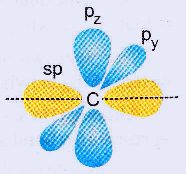
Orientation of the unhybridized orbitals
Whenever carbon is bonded to two other atoms or groups it always uses sp hybrid orbitals and two 2p (py and pz) orbitals to form its bonds. For example, acetylene.
Bonding in acetylene
BONDING IN ACETYLENE
In acetylene (H-C≡C-H) each carbon atom is attached to one hydrogen atom by a single covalent bond and to another carbon atom by a triple bond. Since each carbon is attached to two other atoms it uses sp hybrid orbitals and two unhybridized 2p orbitals (py and pz) to form its bonds.
In acetylene there are two C-H single covalent bonds and one C-C triple bond. Each C-H bond is a sigma bond and results from the overlap of an sp orbital from carbon and 1s orbital from hydrogen.
One of the three bonds in C-C triple bond is also a sigma bond and results from the linear overlap of the two sp orbitals, one from each carbon.
The other two bonds in the triple bond are pi bonds and results from the lateral overlap of the unhybridized p orbitals on each carbon.
Formation of the two pi bonds in acetylene
Although the C-C triple bond is represented by three equivalent lines, remember that one line represents a sigma bond and the other two the pi bonds. 
Triple bond in acetylene

Problem with Organic Chemistry? Check this out!

sp2 HYBRIDIZATION OF CARBON

The electronic configuration of carbon in its ground state is:
Ground state
The promotion of one of the two 2s electrons to the empty pz orbital give the excited state.
Excited state
At this point we follow a different course than that used for sp3 hybridization, in which case one 2s and three 2p orbitals were mixed. Instead, the 2s electron and just two of three 2p orbitals are mixed or hybridized to give three new equivalent orbitals. These new orbitals are referred to as sp2 orbitals, because they are formed by interaction of one s and two p orbitals. Third 2pz orbital is left unhybridized. The electronic configuration of the carbon atom in its sp2 hybridized state is:
Hybridized state
Each sp2 orbital has an unpaired electron. The shape of sp2 orbital is similar to that of an sp3 orbital.
Formation of three equivalent sp2 orbitals
The sp2 orbitals obtained are identical, that is, they have the same energy and shape. They differ only in their orientation in space with respect to each other. The three sp2 orbitals lie in the same plane with their axes directed towards the corners of an equilateral triangle. The angle between any pair of orbitals is 120°.
Orientation of three sp2 orbitals
The smaller lobes are not indicated because they do not extend sufficiently far from nucleus to participate in bond formation. The trigonal arrangement is favoured because it allows the sp2 orbitals to stay as far apart from each other as possible and thereby reducing the electron-electron repulsion.
The unhybridized pz orbital is oriented along an axis perpendicular to the plane of sp2 orbitals, with each lobe above and below the plane of the sp2 orbitals. 
Orientation of the pz orbital
Whenever carbon is bonded to three other atoms or groups it always uses sp2 orbitals and a pz orbital to form its bonds. For example, ethylene. 
BONDING IN ETHYLENE
Each carbon atom in ethylene (H2C=CH2), is attached to two hydrogen atoms by single covalent bonds and to another carbon atom by a double bond. Since each carbon is attached to three other atoms, it uses sp2 hybrid orbitals and an unhybridized pz orbital to form its bonds. 
Bonding in ethylene
In ethylene there are four C-H single covalent bonds and one C-C double bond. Each C-H bond is a sigma bond and results from the overlap of one sp2 orbital from carbon and 1s orbital from hydrogen.
One of the two bonds in the double bond is also a sigma bond and results from end-to-end overlap of the sp2 orbitals, one from each carbon atom.
The second bond in the double bond is a pi bond results from the lateral overlap of two unhybridized pz orbitals, one from each carbon atom. pz orbitals can overlap only when all the six atoms lie in the same plane, that is, the plane of sigma bonds. Like the p orbitals from which it is formed, a pi bond consists of two equal parts. One part lies above the plane of the carbons and hydrogens and the other part lies below this plane. These two parts together make up one pi bond. 
Formation of the p bond in ethylene
 Although the C-C double bond is represented by two equivalent lines, remember that one line represents a sigma bond and the other the pi bond.
Double bond in ethylene


Sunday, 14 June 2015

Problem with Organic Chemistry? Check this out!

sp3 HYBRIDIZATION OF CARBON

In terms of energy level diagram, the electronic configuration of the carbon atom in its ground state may be represented as:
Ground state
Since there are only two unpaired electrons or half-filled orbitals, it might be expected that only two single covalent bonds will be formed.
On this basis, carbon would combine with two hydrogen atoms (H=1s1) to form a molecule CH2. The two C-H bonds would be formed by overlap of the 2p orbitals (px and py) with the 1s orbital of each hydrogen atom. Since the angle separating the p orbitals is 90°, the C-H bonds would be at right angles to each other. But from chemical analysis we know that the simple stable compound that carbon forms with hydrogen is methane (CH4) and this compound contains four identical C-H bonds.
Now let’s assume that one of the 2s electrons in the ground state is moved to the empty pz orbital. Since 2pz orbital is at a higher energy level than the 2s orbital, this promotion process would require some input of energy. This energy is supplied in the form of heat or light. This new state of carbon is referred to as the excited state. In terms of energy level diagram, the electronic configuration of the carbon atom in its excited state is:
Excited state
Since there are four unpaired electrons or half-filled orbitals in the valence shell of the carbon atom in its excited state, it might be expected that four covalent bonds will be formed. On this basis, carbon would combine with four hydrogen atoms to form a CH4 molecule. The three C-H bonds would be formed by the overlap of three 2p orbitals (px, py and pz) with the 1s orbital of each hydrogen atom. The 4th C-H bond will be formed by the overlap of the 2s orbital of carbon with the 1s orbital of a hydrogen atom. Since the angle separating the p orbitals in an atom is 90°, the three C-H bonds may be expected to be at right angles to each other. The 4th C-H bond involving the overlap of s orbitals will not have any directional characteristics because s orbitals are spherically symmetrical. This implies that two different types of C-H bonds are involved in the formation of methane molecule, right? Wrong! Experimentally, methane has been shown to contain four identical C-H bonds that are directed towards the corners of a regular tetrahedron.
To form four identical bonds, carbon must contribute a set of four equivalent orbitals. This can be achieved if the 2s and the three 2p orbitals in the excited state are mixed or hybridized to give four new equivalent orbitals. These new orbitals are known as sp3 orbitals. Mixing of a pure s orbital and three p orbitals is like mixing of a gallon of pure red paint and three gallons of white paint to give four gallons of pink paint. This process of mixing of pure orbitals to give a set of new equivalent orbitals is termed as hybridization and the carbon is said to be in hybridized state. The electronic configuration of the carbon atom in sp3 hybridized state is:
Hybridized state
In terms of energy level diagram, the above electron configuration may be represented as:
Four equivalent sp3 hybrid orbitals
Each sp3 contains one electron. Since each sp3 orbital is obtained from one s and three p orbitals, it has 25% s-character and 75% p-character. Each sp3 orbital has a large lobe and a small lobe.
Shape of  an sp3 hybrid orbital
The four new sp3 orbitals obtained are identical (same energy and shape) but differ only in their orientation in space with respect to each other. The four sp3 orbitals are arranged in such a way that their axes are directed towards the corners of a regular tetrahedron with carbon located at the centre. The angle between any two orbitals is therefore, 109°28’. The smaller lobes are not indicated because they do not extend sufficiently far from nucleus to participate in bond formation.
Orientation of four sp3 hybrid orbitals
The tetrahedral arrangement is favoured because it allows the sp3 orbitals to stay as far away from each other as possible and thereby reducing the electron-electron repulsion. This is in keeping with the fact that each sp3 orbital contains an electron, and electrons stay as far apart as possible because they have the same charge.

BONDING IN METHANE

In methane carbon forms single covalent bonds with four hydrogen atoms. Since the carbon atom is attached to four other atoms it uses sp3 orbitals to form these bonds. Each C-H bond is the result of an overlap one sp3 orbital from carbon and 1s orbital from hydrogen. 
Bonding in methane
Since the four sp3 orbitals are oriented in such as a way that their axes are directed towards the corners of a regular tetrahedron with carbon located at the centre, the resulting C-H bonds are also directed towards the vertices of a tetrahedron with carbon at the centre. Thus, the bonding angles in methane are the same as the angles between the axes of the sp3 orbitals, that is, 109°28’.
The covalent bonds formed by the overlap of sp3 orbitals and s orbitals are sigma bonds because the electron density in each bond is symmetrical about the line joining the centre of two bonded atoms. Thus, all C-H bonds in methane are sigma bonds.