Showing posts with label Biology. Show all posts

Saturday, 18 June 2016

The Power of Power Naps

POWER NAPS CAN CHANGE YOUR LIFE

Feeling groggy, tired or unmotivated in the afternoon? Using coffee, soda and energy drinks we often try to push through the dreaded long day yawning through the hours and fighting the fatigue. But just so happens that the solution is the very thing we’ve been trying to avoid all day long, sleep. The truth is, the power nap is perhaps the most effective way to rejuvenate our brain.
Lack of sleep
There are four main stages of our sleep cycle. The first two are relatively light sleep, while the third brings us into a deep slumber. The final stage known as rapid eye movement or REM for short, is where most of our dreams begin. The benefits of napping are tied to length of time in which we are asleep. Naps thirty minutes in length generally only allow time to enter the first stages. In stage one, slow eye movement begins and if woken we often feel as though we didn’t even sleep. But as we continue into stage two, our brain begins to inhibit processing and ignores external stimuli that it deems non-dangerous in order to relax us and give us a tranquil sleep. It also begins memory consolidation, in which information we learn is processed. Waking at the end of these stages has shown benefits including increased productivity, increased cognitive function, enhanced memory, boosted creativity and most importantly, feeling less tired. Beyond thirty minutes we enter stage three and experience something known as sleep inertia when awakened. This is because our body is coming out of a deep sleep, motor dexterity is decreased while grogginess and the longing to go back to sleep increases.
Dreaming- Final Stage
Many people falsely deem naps non-beneficial for themselves. But the truth is, they have simply napped too long. As the benefits of napping became clearer, many nap salons were opened throughout Japan where workers can pay to have a brief lunch time nap on a daybed to increase alertness at work. So maybe it’s about time we all start sleeping on the job a little more. Just tell your boss, “Science said so.” 

Power nap

Tuesday, 16 June 2015

The Science of Love

WE LOVE BEING IN LOVE

From philosophers and historians, to poets and scientists alike, love has captured our imagination and curiosity for centuries. Many have experienced the rush of falling in love for the first time or the deep feelings of love for our family and friends. But what is love from a biological perspective? No doubt it’s intertwined with the evolutionary survival of our species. After all we come from an unbroken line of organisms reproducing from the very first microbe that split in two, to our ancestors who have all successfully mated since the dawn of time. Sadly, if we fail to have children this perfect streak comes to a halt. But while we are driven to reproduce, we are also driven to make sure our offspring survives.
Though we often associate love with the heart, the true magic can be seen inside the brain. It may not be entirely surprising to find out that the brain of somebody in love looks awfully similar to one on cocaine. Cocaine acts on the pleasure centres in the brain by lowering the threshold at which they fire. This means that we feel really good a lot easier.
We see the same thing in the brains of those in love, but it’s not just the cocaine or love that makes us feel good, it’s the fact that anything we experience will now more easily set off pleasure centres and make us feel good. Because of this we not only fall in love with the person, but begin to build a romanticized view of the world around us. Interestingly, nearby pain and aversion centres begin to fire less, so we become less bothered by things around us. Simply put we love being in love. 
I love her!
So what chemicals are at work to make all of this happen? Both during orgasm or by simply looking at photos of a loved one, there is a surge of dopamine and norepinephrine from the ventral tegmental area. This not only triggers sexual arousal and our racing heart, but gives us the motivation, craving and desire to be with the person more and more.
Romantic love
 You see romantic love is not simply an emotion, it’s a drive from the motor of the mind. And this motor brings about intense energy, focused attention and elation. The pleasure centres are part of the brain’s reward system – the mesolimbic dopamine system. If we stimulate this region while learning, learning becomes much easier because it’s pleasurable and perceived as a reward.
Learning as a reward
We also see a surge in the neuromodulator oxytocin from the nucleus accumbens, sometimes called the commitment neuromodulator. This is because in mammals it helps to reinforce bonding or attachment. When prairie voles are injected with either oxytocin or vasopressin they will instantly find a mate to pair a bond with. Finally, studies have shown that people in love have low levels of serotonin which is similar to people with obsessive compulsive disorder. This is likely the cause of our obsession and infatuation during early love. Amazingly, these areas associated with intense romantic love can remain active for decades, and while there are many other physiological and psychological components that add to the mix, the truth is, science still knows very little about exactly why or how it works. Yet, somehow we all seem to know it when we feel it.

Thursday, 4 June 2015

A bizarre mating ritual

THE MALE ANGLERFISH GETS COMPLETELY SCREWED

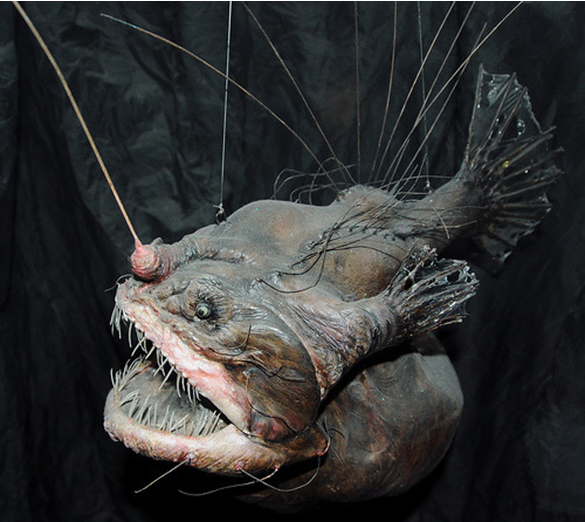
The angry looking deep sea anglerfish has a right to be cranky. Most who have seen it find it the ugliest creature on the planet. It lives in what is easily Earth’s most inhospitable habitat- the lonely, cold and lightless bottom of the sea. But despite its looks, it is an incredible example of adaptation and survival in most extreme environment.
Anglerfish
From birth, a male angler fish is basically worthless. He’s small, weak and can barely find food. However, he’s born with a great sense of smell, which becomes the driving force behind his existence. The smell is actually the pheromone of a flirty female anglerfish, which he will search for his entire lifetime.
Male anglerfish


Female anglerfish
The female anglerfish is huge, vicious and capable. More than 250 different species of anglerfish have a lure, an appendage that they use to catch other fish for food. Protruding from the top of the fish’s head, the lure is long and thin, and often has a feathery end that attracts prey. The Black Sea dragon, a deep water anglerfish, has a lure with an added attraction. In the dark depths of the ocean, light producing bacteria live in this lure. The bacteria and Black Sea dragon benefit from this relationship. The bacteria feed off the Black Sea dragon, and their glow attracts other fish, which may end up as a delicious meal for the sea dragon.
The lure of an anglerfish attracts prey
Once the mating partner is found by following sexual scent released by the female, this bizarre mating ritual begins. The male, upon seeing her, will realize his calling in and he’ll start biting her.  While biting, his lips will start to melt. This is because when the male hooks itself to the with small teeth, he releases an enzyme which digests the skin of his mouth and her body, enabling the fusion of the two with the male becoming a parasite as their blood vessels join. Then, his eyes and internal organs will also start melting and fuse into the side of the female’s body. Eventually, his entire body will fuse into hers and he will totally depend on female nourishment. The only thing that will remain is a pair of gonads which the female can later use to impregnate herself. Basically, he becomes a pair of shiny new testicles for the female. Balls are like snowflakes, they are unique and beautiful, and every animal is allowed only one pair. A female anglerfish, however, defiles this notion and carries six or more males on her body which make sperm instantly available whenever she is ready to reproduce.
Anglerfish mating
 So, if you are ever in the mood for some real life horror, catch a video of the anglerfish.

Sunday, 31 May 2015

The science of pornography addiction

PORNOGRAPHY ADDICTION

Sexual tastes vary from person to person. But with the current pornography epidemic as some call it, one has to wonder how exactly this may affect our desires and perception of sexuality. Moreover, how does it affect our sex lives. Pornography constitutes about 25% of all search engine requests, and is the 4th most common reason people give for going on the internet. And well may seem to simply facilitate an instinctual sexual response linked to millions of years of evolution. The truth is pornography has dynamically changed over time ultimately moulding our tastes and desires. The not so shocking truth is that pornography has profound consequences for the brain and acts in many ways like a drug.

Internet porn
With prolonged exposure our tolerance is increased and many often find themselves addicted. Though it is not a physical substance, it leads to the same general loss of control, the compulsiveness to seek out the activity despite negative consequences and withdrawal when it goes away. Much like that of gambling or running for example. The issue is the continued exposure can cause long term or even lifelong neuro-plastic change in the brain. During sexual process, the brain begins narrowing its focus as it releases a tidal wave of endorphins(any of a group of hormones secreted within the brain and nervous system and having a number of physiological functions) and other neurochemicals like dopamine(creates a sharp focus on finding porn), norepinephrine(makes the brain more alert and ready for action), oxytocin(binds the person to the images he sees) and serotonin(elevates someone’s overall sense of excitement and enjoyment). These “natural drugs” produce a tremendous rush or high. 
Dopamine
 
Serotonin
 
Norepinephrine
Dopamine is released as reward whenever we accomplish something whether it be eating to sustain life or sexual activity to produce future life. And this dopamine consolidates neural connections in order to drive us to perform the activity in the future. In other words, it alters and forms the brain cells to motivate certain actions. It rewires our brain. The national institutes of health measure drug addictiveness by testing rats. The rat is trained to press a button in order to get a drug, and the harder it works indicates how addictive the substance is. It turns out that the more addictive a drug is, the more dopamine we see released. And while there is unfortunately no rat porn that we can give to them, we do know that dopamine is also released during sexual excitement which pornography plays right into. The more time we spend doing it, the more dopamine gets released which reinforces the behaviour and makes us not only desire it in the future but require it. And as we begin to imagine these images away from the computer or while having sex, they become reinforced. Further more each orgasm releases even more dopamine which consolidates the connections made during the session. It’s a feedback loop that becomes harder to escape and just like a drug our tolerance for visual stimulation has now compounded, making it more difficult to be turned on by reality. Pornography addiction can often lead to finding our mate less attractive. 
Dopamine causes addiction
 The good news is, it doesn’t have to permanent. Usually when people understand the mechanism and realize it’s affecting their relationships, they can stop. There is logical, scientific explanation behind how and why individuals get trapped in pornography addiction, there is also a tested and proven process for getting them out. The brain is often described as a “use it or lose it” system because the neural connections we stimulate grow stronger and desire to be activated while the ones you ignore become weakened. Much like our muscles which if sitting all day itch for activity but after prolonged non-use they become complacent. Luckily, because this “use it or lose it” brain, the same neuro-plastic system that proliferates these habits can also also be used to acquire healthier ones. 

Saturday, 30 May 2015

Childbirth vs Getting kicked in the Balls

WHICH ONE IS MORE PAINFUL – CHILDBIRTH OR GETTING KICKED IN THE BALLS?


Childbirth vs getting kicked in the balls
In the battle of sexes we are fiercely divided, who has a worse when it comes to pain?
On one hand women are left with the task of fitting a watermelon sized object through a coin sized hole. On the other hand, males protest that even the slightest nick of their family jewels can leave them incapacitated. So, which hurts more childbirth or getting kicked in the balls?
There is a rumor circulating the internet claiming the human body can take up to 45 del units of pain and yet a mother feels up to 57 del of pain during childbirth, which is apparently equivalent to 20 bones being fractured once. The claim then goes on to suggest that being kicked in the balls brings more than 9000 del of pain. Now apart from the absurd logic that both of these events can surpass the alleged human limit it actually uses a unit of pain, the del, which doesn't even exist. There is a unit of pain once devised called dol, from the Latin word for pain dolor.
The del system
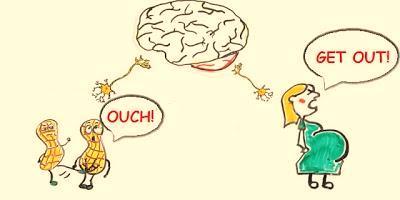
To really evaluate this question we first need to understand what pain is, which isn't an easy task. There is actually a group of specialized nerve cells in our body called nociceptors that react to pain. Unlike other nerves which readily fire in response to normal touch or temperature, nociceptors will only fire once a certain pain threshold has been passed. Some of these nociceptors respond quickly sending signals to the spinal cord and brain which produce sharp and sudden pain, allowing us to react quickly. While others transmit more slowly and are responsible for the prolonged dull ache we feel.
For males, testicles are internal organs that have migrated out of the body cavity. Some internal organs such as liver feel no pain, others like testicles covered with many nociceptors make them extremely sensitive. After all their well being is of utmost importance. Further more the testicles are attached to many nerves in the stomach as well as the vagus nerve which is directly connected to the brain's vomit centre and this is why when hi the pain spreads throughout the abdomen. The fact that testicles have minimal protection only strengthens the accompanying symptoms of nausea, increased blood pressure, heart rate and sweating.
But not so fast gentlemen, even though childbirth may not be facing a direct blow to any internal organs, the mechanical distension of uterine area also triggers nociceptors and causes the same kind of visceral pain. Also consider that throughout evolution female human hips have become smaller while baby heads have become larger. And no to mention labour lasts 8 hours on average with a mixture of nausea, fatigue and pain. On top of it all, tension and stretching of muscle and tissue increase as labour intensifies creating sharp and localized pain.
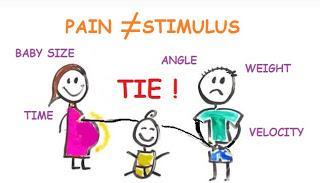
Okay, so both obviously hurt and have a lot of mechanical stimulation sending signals to pain centres of the brain. But this is where it gets tricky, because the pain isn't simply a physical response but rather a partially perceptive or subjective experience. This means that every single individual perceives pain in a slightly different way. And not only between individuals but depending on our mood, alertness or even previous experience pain may affect us differently. It's for this reason that so many attempts to objectively measure pain have failed including dol system. Interestingly nearly 80% of upper limb amputees experience a  phenomenon known as phantom limb pain, that is, they feel pain in a limb that is no longer there. And while little is understood about the mechanism of pain , it is clear that there is no particular input to trigger the response and yet they still feel a very real pain. As such pain is not a stimulus, it is an experience that is different for everybody. Suffice to say both instances of childbirth and getting hit in the balls can hurt a lot. So we call this one a tie, apart from the fact that the experiences are completely different and there are so many variables to consider. In some instances a man could experience more pain than his female counterpart and vice versa. The main difference being one results in  a new born baby, while the other potentially results in a decreased chance of having one.
It's a tie


Music is addictive

MUSIC - THE NATURAL DRUG OF HAPPINESS

 Whether it's Mozart, Joni Mitchell, Adele or newcomers like Frank Ocean music is powerful and has existed in all cultures throughout history. But why do humans find music so addictive and pleasurable?
Dopamine
At its core, music is the combination of audio frequencies and intricate patterns floating through the air and clashing together in our ear. Much like our eyes process light, our ears process waves of sound and trigger a state of excitement and sometimes pleasure in our brain. Humans experience pleasure from many stimulants food, sex and drugs. But because many of these stimulants are necessary for human survival the body has created a system in which it rewards us for achieving them. What's really happening is a release of a neurotransmitter in the brain called dopamine. Dopamine is a chemical responsible for making us feel good. When dopamine is released following a reward such as a delicious meal or winning the lottery, the neurotransmitter causes a feeling of pleasure and satisfaction. Drugs, such as cocaine, take advantage of this pathway by increasing the amount of dopamine, or rather, preventing its removal causing continual stimulation of our neurons, which creates intense moments of pleasure.  
Music is addictive
Music has the ability to create state of arousal causing pupils to dilate, blood pressure to rise and the brain to fire in auditory, movement and emotional regions. And even though music doesn't have a direct survival benefit, this emotional reaction causes a release of the feel good chemical, dopamine. Though the exact evolutionary reasoning is unclear, the amazing fact remains, music chemically alters our body and makes us feel great. And in the same way that a drug induced dopamine surge leaves us craving more, music becomes addictive. The dopamine tells our body it was rewarded and creates the desire to seek out more. 
Even though music enjoyment is entirely subjective and intertwined with cultural and personal experience, the chemical effects remain constant amongst the human race, a perfectly natural drug of happiness.

Weird defense

SOME WEIRD DEFENSE MECHANISMS

Some reptiles, such as the crocodile and the venomous snake, are notorious predators. But did you know that most reptiles are also prey? Other animals, including birds and small mammals, go after reptiles’ eggs and young. And reptiles have certainly been known to go after other reptiles as well. Lizards in particular have to worry, because their small size makes them appealing as food for birds, snakes, and carnivorous mammals. To protect themselves from danger, lizards have devised some unusual defences.
  • Armed [and dangerous?]
Some lizards, such as the thorny devil, have prickly “horns” protruding from their skin. These small bones are called osteoderms, meaning “bony skin. “ FYI,     the ridges on the back of an alligator are also osteoderms. This hard, bony layer protects the lizard’s body from being pierced or stabbed by an enemy.  A predator sees an armoured lizard and decides it’s way too much trouble to eat.
Thorny Devil
  • Run for your life!
The first line of defense is evasive action. Move quickly; find a safe place to hide. Some lizards can run very fast using bipedal locomotion, which means using just their hind legs. The basilisk has perfected bipedal locomotion to an artform. As the basilisk slows down, it drops into the water and swims away. 
Basilisk
The iguana has special fringes on its long rear toes that allow it to run over water. It uses its long tail as counterbalance. 
Iguana
  • Camouflage
Most lizards will try to blend in with their natural surroundings. A dappled brown and purple gecko is just the right colour for its rocky desert environment, while a green iguana looks just like the tree branch it’s sleeping on. The chameleon is the best faker of all: it can change its colours to suit its surroundings, choosing from shades of green, yellow, brown and grey. Chameleons have special skin cells, called chromatophores, that contain different pigments. These can move closer to or farther away from the skin, depending on what colour the chameleon’s nervous system says would offer the best disguise. The pigment closest to the skin determines the skin’s colour.
Chameleon
  • Tails of all types
One way to escape a predator is to distract it. The zebra-tailed lizard, when facing one of its foes, will wave its snazzy, black-and-white tail until the predator is practically mesmerized. The lizard can then run away, leaving the attacker in trance and completely stopped in its tracks.
Zebra-tailed lizard
Tail-dropping is another escape technique, although a drastic one. Skinks and geckos have long, slender tails. When a predator grabs the lizard, it contacts its tail muscles. 
Gecko
This causes an area along the tail vertebrae to fracture, so that the lizard’s tail actually drops off. The attacker sees the still-wriggling tail on the ground. , lets go of the lizard, and grabs the tail instead. The lizard runs away and grows a new tail over the next few months. On the downside, the new tail is not quite strong as the original one. And this escape method can only be done once in a lizard’s life.
Skink
  • Some really weird defenses
Scare tactics work, too. The Australian frilled lizard will open its mouth wide, which causes a large frill of skin around its neck to spread out on either side, like a fan. If that weren’t scary enough, it also lashes its tail back and forth and makes loud hissing sounds.
Frilled lizard
The African armadillo lizard has spines all over its body. When threatened, it curls up into a ball and covers its belly with its fence-like, prickly tail.
Armadillo
Some enemies can’t stand the sight of blood. The horned lizard will squirt its own blood from its tiny vessels near its eyes to scare off its attacker. It can also shoot a stream of blood out three feet (1 m).

Horned Lizard