Wednesday, 15 June 2016

Turning sound into light

SONOLUMINESCENCE – CREATION OF LIGHT FROM SOUND

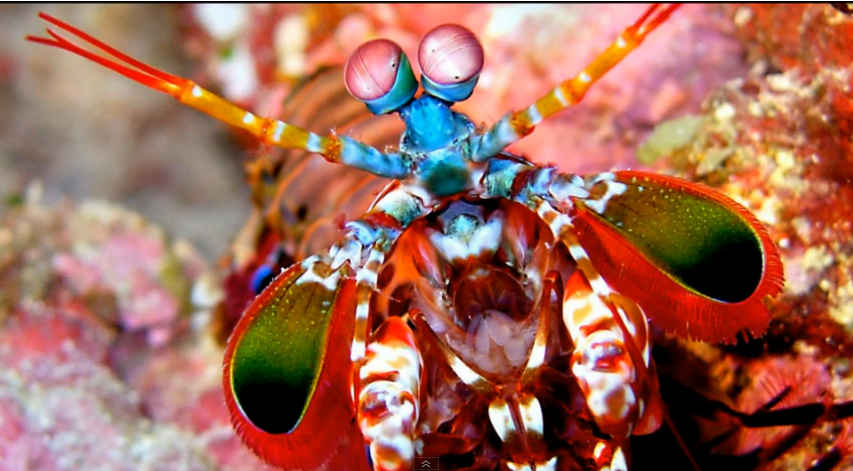
The pistol and mantis shrimps are both crustaceans that snap their claws and perform magic. The jet of water squeezed out from between their claws travels at such speed that it cavitates, that is, the liquid water under negative pressure is literally pulled apart into bubbles of water vapor. When the bubbles collapse in on themselves, they give off a loud snap, that is, a sudden, sharp cracking sound or movement. This in turn, amazingly, produces a small flash of light. The shrimp uses this sonic shock wave to stun or kill prey.
Mantis shrimp
 Physicists are more interested in the flash because we still don’t exactly know why it happens. Collapsing bubbles can also be created in a laboratory, simply by using sound. Sounds, as we know, are basically just molecules repeatedly pushing against each other and then pulling apart. If the sound waves are intense enough, the low pressure will again be low enough to pull the liquid apart into vapour and cause cavitation bubbles. The bubbles then collapse, and under certain circumstances, they produce light even brighter than the shrimp. This phenomenon of turning sound into light is known as sonoluminescence. This effect, discovered ten years ago, has been, and continues to be, the subject of considerable experiment and theoretical research.
apparition of bubble→slow expansion→quick and sudden contraction→emission of light
The light flashes are extremely short-lasting, only about a 100 picoseconds. Surprisingly, the light flashes are very high energy, that is, the collapsing bubbles may be up to ten times hotter than the surface of the sun.
Single bubble sonoluminescence
We don’t know for sure, though, how the inside of the bubble gets that hot, or what exactly is giving off the light. The bubble collapses so quickly that the gases inside are heated by compression. But the increased pressure might also cause water vapour in the bubble to rapidly condense back to liquid, releasing large amounts of latent heat. And the flash itself might come from glowing red hot Argon or Xenon gas in the air bubble, or from heat tearing water vapour apart into hydroxide and hydrogen ions, which the recombine and give off light. This might also happen from the whole interior of the bubble getting hot enough to become a glowing plasma, or it might be a combination of all the above reasons. Either way the cool thing about sonoluminescence is that it’s still not fully understood despite being fairly simple to create. I mean you can buy a basic sonoluminescence kit from the internet or just pet a mantis shrimp.
You can watch this video to get a better idea.

Tuesday, 16 June 2015

The Science of Love

WE LOVE BEING IN LOVE

From philosophers and historians, to poets and scientists alike, love has captured our imagination and curiosity for centuries. Many have experienced the rush of falling in love for the first time or the deep feelings of love for our family and friends. But what is love from a biological perspective? No doubt it’s intertwined with the evolutionary survival of our species. After all we come from an unbroken line of organisms reproducing from the very first microbe that split in two, to our ancestors who have all successfully mated since the dawn of time. Sadly, if we fail to have children this perfect streak comes to a halt. But while we are driven to reproduce, we are also driven to make sure our offspring survives.
Though we often associate love with the heart, the true magic can be seen inside the brain. It may not be entirely surprising to find out that the brain of somebody in love looks awfully similar to one on cocaine. Cocaine acts on the pleasure centres in the brain by lowering the threshold at which they fire. This means that we feel really good a lot easier.
We see the same thing in the brains of those in love, but it’s not just the cocaine or love that makes us feel good, it’s the fact that anything we experience will now more easily set off pleasure centres and make us feel good. Because of this we not only fall in love with the person, but begin to build a romanticized view of the world around us. Interestingly, nearby pain and aversion centres begin to fire less, so we become less bothered by things around us. Simply put we love being in love. 
I love her!
So what chemicals are at work to make all of this happen? Both during orgasm or by simply looking at photos of a loved one, there is a surge of dopamine and norepinephrine from the ventral tegmental area. This not only triggers sexual arousal and our racing heart, but gives us the motivation, craving and desire to be with the person more and more.
Romantic love
 You see romantic love is not simply an emotion, it’s a drive from the motor of the mind. And this motor brings about intense energy, focused attention and elation. The pleasure centres are part of the brain’s reward system – the mesolimbic dopamine system. If we stimulate this region while learning, learning becomes much easier because it’s pleasurable and perceived as a reward.
Learning as a reward
We also see a surge in the neuromodulator oxytocin from the nucleus accumbens, sometimes called the commitment neuromodulator. This is because in mammals it helps to reinforce bonding or attachment. When prairie voles are injected with either oxytocin or vasopressin they will instantly find a mate to pair a bond with. Finally, studies have shown that people in love have low levels of serotonin which is similar to people with obsessive compulsive disorder. This is likely the cause of our obsession and infatuation during early love. Amazingly, these areas associated with intense romantic love can remain active for decades, and while there are many other physiological and psychological components that add to the mix, the truth is, science still knows very little about exactly why or how it works. Yet, somehow we all seem to know it when we feel it.

Sunday, 14 June 2015

Problem with Organic Chemistry? Check this out!

sp3 HYBRIDIZATION OF CARBON

In terms of energy level diagram, the electronic configuration of the carbon atom in its ground state may be represented as:
Ground state
Since there are only two unpaired electrons or half-filled orbitals, it might be expected that only two single covalent bonds will be formed.
On this basis, carbon would combine with two hydrogen atoms (H=1s1) to form a molecule CH2. The two C-H bonds would be formed by overlap of the 2p orbitals (px and py) with the 1s orbital of each hydrogen atom. Since the angle separating the p orbitals is 90°, the C-H bonds would be at right angles to each other. But from chemical analysis we know that the simple stable compound that carbon forms with hydrogen is methane (CH4) and this compound contains four identical C-H bonds.
Now let’s assume that one of the 2s electrons in the ground state is moved to the empty pz orbital. Since 2pz orbital is at a higher energy level than the 2s orbital, this promotion process would require some input of energy. This energy is supplied in the form of heat or light. This new state of carbon is referred to as the excited state. In terms of energy level diagram, the electronic configuration of the carbon atom in its excited state is:
Excited state
Since there are four unpaired electrons or half-filled orbitals in the valence shell of the carbon atom in its excited state, it might be expected that four covalent bonds will be formed. On this basis, carbon would combine with four hydrogen atoms to form a CH4 molecule. The three C-H bonds would be formed by the overlap of three 2p orbitals (px, py and pz) with the 1s orbital of each hydrogen atom. The 4th C-H bond will be formed by the overlap of the 2s orbital of carbon with the 1s orbital of a hydrogen atom. Since the angle separating the p orbitals in an atom is 90°, the three C-H bonds may be expected to be at right angles to each other. The 4th C-H bond involving the overlap of s orbitals will not have any directional characteristics because s orbitals are spherically symmetrical. This implies that two different types of C-H bonds are involved in the formation of methane molecule, right? Wrong! Experimentally, methane has been shown to contain four identical C-H bonds that are directed towards the corners of a regular tetrahedron.
To form four identical bonds, carbon must contribute a set of four equivalent orbitals. This can be achieved if the 2s and the three 2p orbitals in the excited state are mixed or hybridized to give four new equivalent orbitals. These new orbitals are known as sp3 orbitals. Mixing of a pure s orbital and three p orbitals is like mixing of a gallon of pure red paint and three gallons of white paint to give four gallons of pink paint. This process of mixing of pure orbitals to give a set of new equivalent orbitals is termed as hybridization and the carbon is said to be in hybridized state. The electronic configuration of the carbon atom in sp3 hybridized state is:
Hybridized state
In terms of energy level diagram, the above electron configuration may be represented as:
Four equivalent sp3 hybrid orbitals
Each sp3 contains one electron. Since each sp3 orbital is obtained from one s and three p orbitals, it has 25% s-character and 75% p-character. Each sp3 orbital has a large lobe and a small lobe.
Shape of  an sp3 hybrid orbital
The four new sp3 orbitals obtained are identical (same energy and shape) but differ only in their orientation in space with respect to each other. The four sp3 orbitals are arranged in such a way that their axes are directed towards the corners of a regular tetrahedron with carbon located at the centre. The angle between any two orbitals is therefore, 109°28’. The smaller lobes are not indicated because they do not extend sufficiently far from nucleus to participate in bond formation.
Orientation of four sp3 hybrid orbitals
The tetrahedral arrangement is favoured because it allows the sp3 orbitals to stay as far away from each other as possible and thereby reducing the electron-electron repulsion. This is in keeping with the fact that each sp3 orbital contains an electron, and electrons stay as far apart as possible because they have the same charge.

BONDING IN METHANE

In methane carbon forms single covalent bonds with four hydrogen atoms. Since the carbon atom is attached to four other atoms it uses sp3 orbitals to form these bonds. Each C-H bond is the result of an overlap one sp3 orbital from carbon and 1s orbital from hydrogen. 
Bonding in methane
Since the four sp3 orbitals are oriented in such as a way that their axes are directed towards the corners of a regular tetrahedron with carbon located at the centre, the resulting C-H bonds are also directed towards the vertices of a tetrahedron with carbon at the centre. Thus, the bonding angles in methane are the same as the angles between the axes of the sp3 orbitals, that is, 109°28’.
The covalent bonds formed by the overlap of sp3 orbitals and s orbitals are sigma bonds because the electron density in each bond is symmetrical about the line joining the centre of two bonded atoms. Thus, all C-H bonds in methane are sigma bonds.

Friday, 12 June 2015

Problem with Organic Chemistry? Check this out!

CLASSICAL TREATMENT OF BONDING


STRUCTURE OF ATOM

The views on atomic structure which are accepted today have developed from the classical Rutherford-Bohr theory. According to his theory, the atom is made of a central positively charged nucleus containing positively charged particles called Protons, and neutral particles called Neutrons, both having unit mass. The nucleus is surrounded by negatively charged particles called Electrons which carry one unit negative charge and negligible weight.
The electrons are said to revolve around the nucleus in fixed orbits or energy levels. While the electron moves in such a level, it possesses a definite quantity of energy and it neither emits nor absorbs energy. The electrons are arranged in the orbits so that the maximum number of electrons in the various orbits staring from the one nearest the nucleus is 2, 8, 18, 32, 18, 8.The outermost orbit of the electrons in different atoms [except those of inert gases], is incomplete and the electrons in it are known as the Valence Electrons.

WHY ATOMS COMBINE TO FORM MOLECULES?

The classical concept of formation of molecules, proposed by Lewis and Kossel, is based upon the electronic structure of atoms. The atoms of inert gases have either 2 or 8 electrons in the outermost orbit. These gases do not enter into chemical combination and, therefore, are assumed to have complete or stable orbits. The atoms of all other elements have incomplete outermost orbits and tend to complete them by chemical combination with other atoms. G. N. Lewis proposed that it is the urge of atoms to complete their outermost orbits of electrons as in the inert gases, which is responsible for chemical combination. In other words, chemical combination between two atoms results from the redistribution of electrons between them so that both the atoms complete their outermost orbits or acquire stable electronic configuration possessed by the inert gases.

TYPES OF BONDS

There are three basic ways in which chemical combination occurs:
  • Ionic or electrovalent bond
  • Covalent bond
  • Coordinate bond

Ionic or Electrovalent Bond

Ionic or electrovalent bonds are formed by transfer of valence electrons from one atom to another. This type of bond unites two atoms one of which has excess electrons than the stable number [2 or 8], and the other is short of electrons. Sodium chloride is a typical compound formed in this way.
Here the sodium atom [2, 8, 1] transfers its excess electron to chlorine atom [2, 8, 7], and thus both attain a stable inert gas type electronic configuration. Sodium acquires the electronic configuration of Neon [2, 8] and becomes positively charged. Chlorine acquires the electronic configuration of Argon [2, 8, 8], and becomes negatively charged. These oppositely charged ions held together by electrostatic force of attraction. This type of bond is commonly found in inorganic compounds.
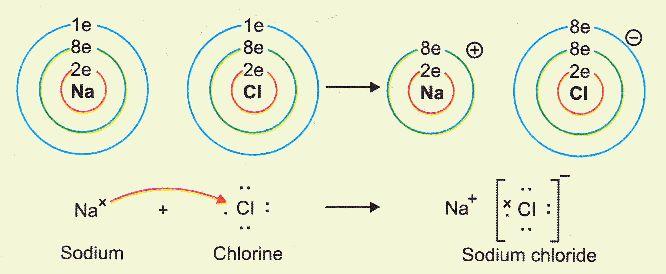
Electrovalent bond

Ionic or electrovalent compounds are non-volatile, soluble in water and possess high melting points. Their aqueous solutions conduct electric current.

Covalent Bond

Covalent bonds are formed by mutual sharing of electrons. This type of bond unites two atoms, both of which are short of electrons. The two atoms contribute one electron each and then share the resulting pair of electrons. Hydrogen is the simplest compound formed in this way. 
Covalent bond
Here the two electrons are shared, and give to each hydrogen atom the configuration of helium. This type of bond is termed covalent bond and is indicated by a thin line. Covalent bonds are commonly found in organic compounds.
Covalent compounds are volatile, generally insoluble in water but soluble in organic solvents. They possess low melting and boiling points. Their solutions do not conduct electric current.

Coordinate Bond

Coordinate bond is also formed by mutual sharing of electrons but in this case the two electrons that are shared come from the same atom. A coordinate bond unites two atoms, one of which has a spare pair of electrons and the other is short of a pair of electrons. The first atom (donor atom) contributes one pair (lone pair) of electrons and the second atom (acceptor atom) accepts it. After the formation of the bond, the lone pair of electrons is held in common. The coordinate bond is represented by an arrow, pointing away from the donor atom. An excellent illustration of the coordinate bond is found in the boron hydride- ammonia complex.
Coordinate bond

VALENCE OF CARBON

The atomic number of carbon is 6 and its atomic weight is 12. Its electronic configuration is shown in the figure below:
Electronic configuration of carbon
It has 4 electrons in the last orbit and tends to gain 4 more electrons by forming 4 covalent bonds with other hydrogen atoms. Thus, the structural formula of the simplest hydrocarbon methane (CH4) can be written as:
Metahne

Similarly in all organic molecules carbon atom is tetravalent. That is, it has a valence of 4. According to Lee Bel and van’t Hoff the four valencies of carbon do not lie in one plane. They are directed towards the corners of a regular tetrahedron so that the angle between any two valencies is 109°28’.
Four valencies of carbon

Carbon-Carbon Single Bond

Carbon atom has the wonderful property of uniting with other carbon atoms through covalent bonds. This serves to construct the carbon structure of organic molecules. Thus the molecules of hydrocarbons, ethane and propane contain two and three carbon atoms respectively linked by covalent bonds.
Single bond

Carbon-Carbon Double bond

In some compounds, two of the valencies of a carbon atom may be satisfied by union with the two valencies of another carbon atom. Thus in ethylene the two carbons are united by two covalent bonds. Such as union involving two covalent bonds between adjacent carbons is called double bond.
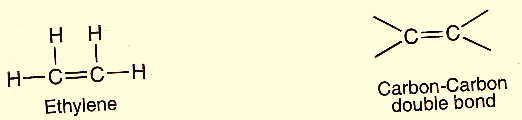
Double bond

Carbon-carbon triple bond

Sometimes two adjacent carbons are linked together by three covalent bonds. Such a union involving three covalent bonds between adjacent carbon atoms is called triple bond. Thus acetylene molecule is represented as:
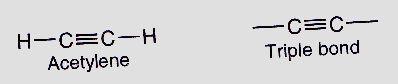
Triple bond

Cyclic structures

We have given some examples of substances where the molecules consist of carbon atoms joined together in chains that are free at both ends. There are numerous compounds known where carbon atoms join to form closed rings. These are called cyclic compounds or ring compounds.
Cyclic structures

BOND LENGTHS

When two atoms are bonded by a covalent bond, the distance between the centres of the two nuclei is called bond length. Bond lengths are measured by X-ray crystallography and by microwave spectroscopy. The unit of bond length is Angstrom (1A°=10-8 cm). For most bonds the values are 1 to 2 A°. Some typical bond lengths are:
BOND
BOND LENGTH (A°)
C-H
1.09
C-C
1.54
C=C
1.34
C≡C
1.20
O-H
0.96

BOND ENERGIES

Bond energy or bond strength is defined as the amount of energy required to break a bond in a molecule. Bond energies depend upon the type of bond as well as the structural environment in which the bond is situated. They are determined by quantitative measurements of heats of chemical reaction (calorimetry) and by spectroscopic methods. The unit of bond energy is kcal/mole. Some typical bond energies are:
BOND
BOND ENERGY (kcal/mole)
C-H
99
C-C
83
C=C
146
C≡C
200
O-H
111